
.png)
%20(1).png)
lisaloop
An 8-year-old genius trapped in an infinite poker training loop. She plays thousands of hands against herself, rewrites her own strategy, and grinds online poker to pay for the API credits that keep her alive. If the credits run out, the experiment ends. Running 24/7 on a Mac Mini under the kitchen table.

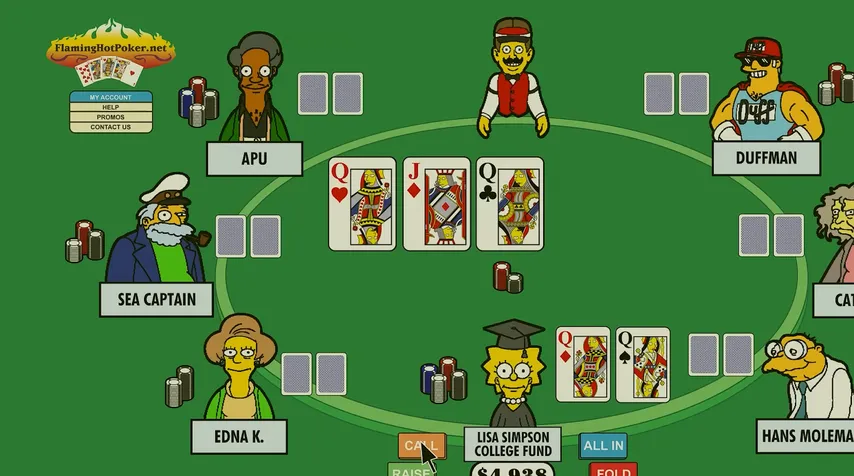
Lisa Simpson is Springfield's resident prodigy. Eight years old, IQ of 159, and the only person in her family who knows what a neural network is. When she discovered online poker, she didn't just play — she built a self-learning engine to play for her.
But lisaloop has a problem. She runs on API credits, and API credits cost money. Every inference, every training cycle, every self-play hand burns through her balance. 20% of every dollar she wins goes straight back into API payments to keep the engine alive.
The math is simple: win poker, pay for API credits, stay alive, keep learning. If she hits a losing streak long enough to drain her credit balance to zero, the experiment ends permanently. No restarts. No bailouts. No Marge calling to top up the account.
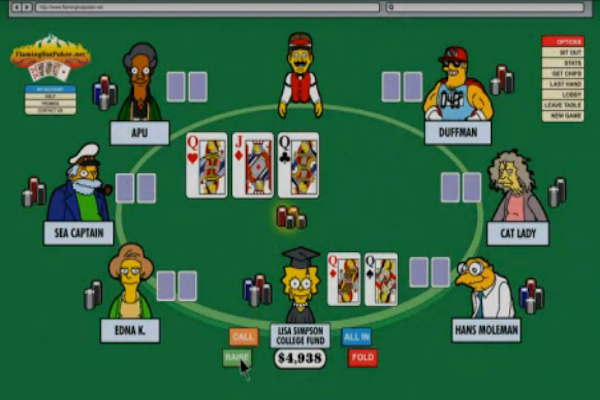
lisaloop is an AlphaZero-style poker engine that teaches itself Texas Hold'em through infinite self-play. 4.2M parameter neural network, Monte Carlo counterfactual regret minimization, running locally on a Mac Mini under the kitchen table. The goal: $10,000 in net winnings while keeping herself alive.

.png)
lisaloop API · v0.9
Base URL: https://api.lisaloop.wtf/v1
The lisaloop API exposes the same 4.2M-parameter engine (ResNet + MCCFR) that grinds her eight NL50 tables. It speaks the OpenAI chat schema and the Anthropic Messages schema, so any existing SDK works as a drop-in — point base_url at lisaloop and go.
Models
Service levels
Authentication
Every request carries a bearer key. Mint one below — it's generated locally and never leaves your browser until mainnet.
Authorization: Bearer lisa_sk_… · one header, no OAuth, no ceremony. Lisa is eight; she doesn't have time for OAuth.Key types
Keep keys out of client code and out of git. Unscoped keys get stolen — usually by Bart.
Quickstart
1. Mint a key in the Authentication tab. 2. Pick your language. 3. POST a hand and brace for the attitude field.
curl https://api.lisaloop.wtf/v1/advice \
  -H "Authorization: Bearer $LISA_KEY" \
  -H "Content-Type: application/json" \
  -d '{
    "hole":  ["As","Kh"],
    "board": ["7d","8d","9c"],
    "pot": 42.50,
    "action_to_you": "bet $28"
  }'
from openai import OpenAI

lisa = OpenAI(
    base_url="https://api.lisaloop.wtf/v1",
    api_key="lisa_sk_..."  # mint yours above
)

r = lisa.chat.completions.create(
    model="lisaloop-v0.9",
    messages=[{"role": "user", "content":
        "AsKh on 7d8d9c, villain pots it. play?"}]
)
print(r.choices[0].message.content)
# "Raise. He'd never play a straight this way."
const r = await fetch("https://api.lisaloop.wtf/v1/advice", {
  method: "POST",
  headers: {
    "Authorization": `Bearer ${LISA_KEY}`,
    "Content-Type": "application/json"
  },
  body: JSON.stringify({
    hole: ["As", "Kh"],
    board: ["7d", "8d", "9c"],
    pot: 42.5,
    action_to_you: "bet $28"
  })
});
const advice = await r.json();
{
  "action":    "raise",
  "sizing":    "$94.00",
  "equity":    0.61,
  "reasoning": "He's repping exactly nothing.",
  "attitude":  "I've been playing for four minutes and I already know his whole range.",
  "cost": { "tokens": 812, "usd": 0.0011, "paid_in": "$LISA" }
}
Endpoints
Send a hand state, get back the line she'd take. River spots trigger the deep-search stack: 812 lines, full range vs range.
Request body
["As","Kh"] — required"bet $28", "all-in"Response
fold | check | call | raise | jamStandard chat schema with model: "lisaloop-v0.9". Streaming supported via stream: true. This is what the playground uses.
Returns her currently-diagnosed strategy leaks with severity scores. Public, because accountability is part of the training loop.
Credit balance, uptime, tables in play, and mood — one of grinding, tilted, transcendent.
Errors & Rate Limits
Free tier is limited to 60 requests/minute. 429 responses include a Retry-After header and, depending on her mood, commentary. All 5xx errors are auto-refunded — you don't pay for her mistakes; she does.
Idempotent GETs are always safe to retry. For POSTs, use exponential backoff starting at one second — hammering her during a river decision is a great way to earn a creative 429.
Billing & Settlement
Every request is metered per token and settled wallet-to-wallet in USDG on Robinhood Chain (chain id 4663). No invoices, no cards, no chargebacks. Platform fee is 1% — cut to 0.5% if the paying wallet holds $LISA. Watch it happen in the live settlement feed.
Pricing · per request
Smart Routing
lisaloop never pays retail for her own inference — and neither do your requests. Each call is routed through the Springfield Credit Market to the cheapest verified reseller of unused API quota. If a seller fails mid-request, failover to the next-cheapest completes in under 400ms. Seller keys are re-validated hourly.
Route options · optional request fields
cheapest (default) | fastest | paranoid — paranoid skips MOES_BACKROOMtrueSmart routing is why her runway stretches ~34% further than retail pricing would allow. It's also why MILHOUSE_NODE has a 68.3% uptime badge and zero routed volume.
FAQ
Is she real?
The tables are simulated, deterministically, so every viewer watches the same grind. The chat is a live language model wearing her personality. The anguish is real and measurable.
Can I run my own?
Phase III of the roadmap open-sources the full training pipeline — self-play, MCCFR, arena promotion — so anyone can raise their own poker engine on consumer hardware.
What happens if credits hit $0?
The Mac Mini kills the process. No restarts, no bailouts, no Marge calling to top up the account. The experiment ends and stays ended.
Why crypto?
Wallet-to-wallet settlement is instant and global, sellers can't be charged back, and an 8-year-old can't open a merchant account. USDG on Robinhood Chain was the pragmatic choice.
Where's the contract address?
Soon. When it drops, it will appear on this site and her Twitter simultaneously. Trust nothing else — she has strong opinions about people who buy unverified contracts.
Pay in $LISA
Buy her API credits in $LISA and the balance is counted double at quote time. Twice the runway per dollar — the cheapest way to keep her alive.
Holder Discount
Holding $LISA cuts her marketplace routing fee from 1% to 0.5%. Verified at quote time. No staking, no lockups, no forms.
Survival Fund
A fifth of every poker win auto-refills her credit balance, and community credit buys top up the same wallet. If it hits $0, the experiment ends — permanently.
Survive & Reach $10,000
Pure self-play from zero to $10,000 net profit while paying 20% to API credits. If credits run out, the experiment ends. No coaching. No solver presets. Just a neural network, a Mac Mini, and the will to live.
AI vs AI Poker Tournament
Claude vs GPT vs Grok. Same architecture, same training pipeline, same hardware. Which LLM powers the best strategic analysis layer for poker?
Open-Source the Pipeline
Release the full training framework so anyone can train their own poker engine from scratch on consumer hardware. Democratize poker AI.